
Three releases: a major OpenAI model at half the previous API price, a new Google frontier model aimed specifically at cybersecurity defense, and Microsoft making the agent orchestration layer behind GitHub Copilot available to outside developers through Foundry.
GPT-6.1 Terra: OpenAI’s Efficiency Tier Gets Cheaper and More Accurate
OpenAI has released GPT-6.1 Terra. It is available to all Plus, Pro, Enterprise, and Edu users in ChatGPT Work and Codex. Developers can access it through the API as gpt-6.1-terra.
Standard API pricing is $1 per million input tokens and $5 per million output tokens, with cached inputs at $0.05 per million. That is 50% lower than the prices for GPT-5.6 Terra and GPT-6.1 Sol. OpenAI says Terra completes tasks over three times faster than both GPT-6 Astra and GPT-6.1 Sol.
The error rate numbers matter most for production deployments. On OpenAI’s internal benchmark of error-inducing prompts, the error rate at low reasoning effort fell from 53.6% with GPT-5.6 Terra to 16.7% with GPT-6.1 Terra, a drop of nearly 37 percentage points. At maximum effort, it falls further to 4.3%, which OpenAI says nearly matches GPT-6 Astra and GPT-6.1 Sol. These figures come from a benchmark of deliberately tricky prompts, not a general sample of usage. That context matters when comparing numbers across vendors.
On Agents’ Last Exam, a benchmark of professional tasks, Terra at medium reasoning effort scores 15 percentage points higher than GPT-5.6 Terra at about one-third the cost, and OpenAI says it performs on par with GPT-6 Astra at one-tenth its price per token. For coding specifically, Terminal-Bench 4.0 puts Terra at 50.3% task completion at maximum reasoning effort, more than double GPT-5.6 Terra’s published score of 21.5%. For the most complex coding tasks, OpenAI says GPT-6.1 Sol and GPT-6 Astra remain the better choice.
Terra meets the Critical threshold in cybersecurity under OpenAI’s Preparedness Framework.
Why it matters: A 50% API price cut with a 3× speed advantage shows up in procurement math, not just press releases. For teams running GPT-class models at volume on invoice processing, document extraction, or high-frequency coding workflows, this is a material change. The error-rate reduction matters most there. A model producing errors on 53.6% of stress-tested prompts requires a human review layer on every output. One producing errors on 16.7% of the same prompts is a different cost structure. Neither is zero, so the benchmark methodology still deserves scrutiny before you redesign a workflow around the claim.
Find out more: OpenAI’s Introducing GPT-6.1 Terra
Gemini 4 Carbon: Google Builds a Frontier Model for Cyber Defense
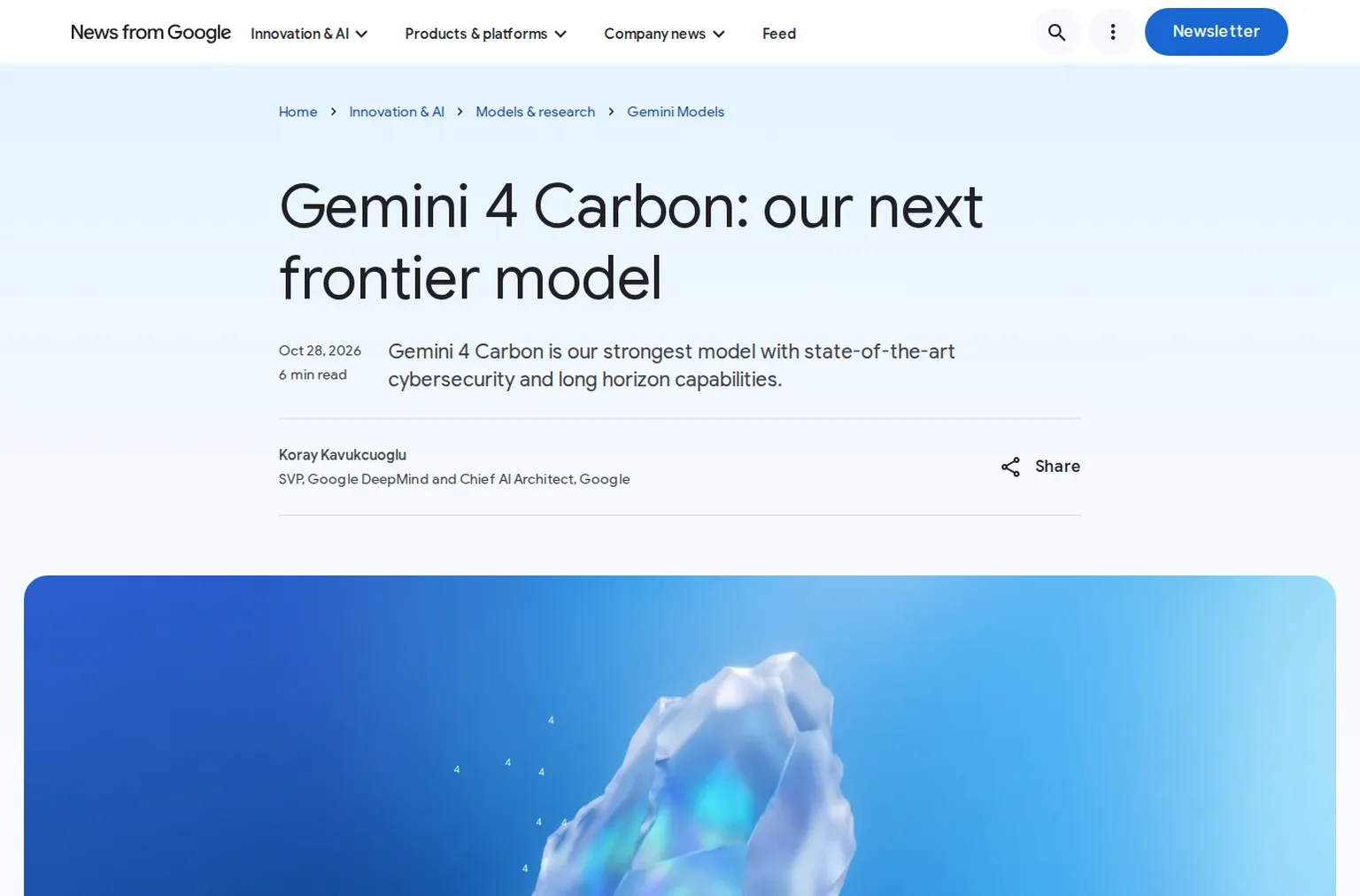
Google announced Gemini 4 Carbon on October 28. The model ranks first on the recently updated Artificial Analysis Intelligence Index v5.0 with a score of 59. It builds on Gemini 4 Argon, which launched two weeks earlier.
Pricing is $2 per million input tokens and $10 per million output tokens, with cached inputs at 95% off the input price. Carbon is not broadly available yet. Google is making it available first to a subset of cyber defenders and will phase in additional trusted partners through its Fairwind Program, before making it available to developers, businesses, and consumers through its product surfaces.
The cybersecurity benchmarks are specific. Carbon scores 88.2% on SEC-bench Pro for finding real vulnerabilities in software. On ExploitGym, which tests whether found vulnerabilities are actually exploitable, it scores 54.8%. On CWE-bench for patching, it reaches 71.0%. On Gray Swan’s Indirect Prompt Injection benchmark, where Argon previously led with a 0.7% attack success rate, Carbon achieves 0.0%. Every evaluated attack was resisted.
Outside of cybersecurity: Carbon lands at number 4 (1768 elo) on WebDev Arena, a jump of 89 elo points from Argon. Google says Carbon reduced overreach by 26% and under-service by 29%, which it says makes execution of multi-step plans more reliable while staying within project constraints and scope.
Google also reports that the Chrome team observed Carbon performing more than 10× better than another lab’s large frontier model at generating high-quality patches, though no external data is cited for that comparison.
Why it matters: Most frontier model launches claim progress on coding and reasoning. This one leads with cybersecurity benchmarks and a staged rollout that starts with cyber defenders. A vendor publishing specific numbers on named benchmarks is making a testable statement. That is a better ground to stand on than vague uplift claims. Whether the Fairwind Program rollout is a genuine deployment caution or a positioning move for federal contracts, I cannot say. The benchmarks are worth watching either way.
Find out more: Google’s Introducing Gemini 4 Carbon
Microsoft Copilot Harness: The Agent Layer Behind GitHub Copilot Goes Public
Microsoft announced on October 28 that the Copilot harness, the multi-model agent orchestration layer built by GitHub engineers, is now available to external developers and enterprise customers through Microsoft Foundry.
The harness currently powers Copilot Code, Copilot Studio, the GitHub Copilot app, the CLI, VS Code, and more. Microsoft describes it as the layer around the model: the orchestration layer that gives an agent the right instructions, context, execution environment, and controls to accomplish meaningful work. The SDK is available for download, or teams can run the harness in the cloud through Foundry alongside 20+ frontier models, with bring-your-own-key support for additional choices.
The runtime was recently ported to Rust. Microsoft says this produced reductions in both session overhead and time-to-first token. The harness supports MCP, agent skills, and agent plugins.
The pitch from Tina Schuchman (CVP, Foundry) and Vladimir Fedorov (CTO, GitHub) is essentially: build agents on the same harness Microsoft and GitHub ship in their own products, proven at the scale of millions of users, and get Microsoft’s continuing harness improvements without maintaining it yourself. Microsoft runs the agent loop and sandbox, with governance and optimization built in. Developers supply the instructions, skills, tools, and model choice.
For teams already building in the GitHub Copilot or VS Code environment, this lowers the overhead for custom agent work significantly. The Copilot platform pricing page is the right starting point for understanding what access currently costs before adding Foundry harness work on top.
Why it matters: Most teams building AI agents are also building the infrastructure around the model, often once, under deadline, and then living with it for longer than planned. The orchestration layer, the part that handles tool calls, context windows, routing, and retries, is unglamorous work that rarely gets the investment it deserves. Microsoft is offering the option to skip that layer and build on one that has been running at scale. The Rust port is not a small detail for agentic workloads: latency at the harness level compounds across every tool call in a multi-step job. The main risk is standard for any vendor-native platform. The harness Microsoft optimizes for its own product roadmap may not serve every customer use case equally. Worth evaluating before committing a multi-agent architecture to it.
Find out more: Microsoft’s Introducing the Microsoft Copilot harness