
Three AI announcements from Monday, November 9. Anthropic released Claude Fable 5.2, and it took the top spot on the Artificial Analysis Intelligence Index. Meta released the smallest and most efficient model in its Muse lineup for running agents at scale. Google announced two new TPU systems, one for confidential inference and one for massive context windows. All three are worth knowing.
Claude Fable 5.2 Debuts at #1 on the Artificial Analysis Intelligence Index
Image: Anthropic
Anthropic released Claude Fable 5.2 and Claude Mythos 5.2 on November 9. On the Artificial Analysis Intelligence Index, Fable 5.2 scores 65, placing it first out of 74 models on the index. Gemini 4 Carbon is second at 60. That is a 5-point gap.
Fable 5.2 and Mythos 5.2 are the same underlying model. Fable ships with cybersecurity and biology safeguards, which is what allows Anthropic to make it broadly available. Mythos is the same model without those safeguards, available to vetted organizations through Anthropic’s Life Sciences and Cyber Verification Programs. That access path is relevant if you are doing biomedical research or cybersecurity work that runs into Fable’s guardrails.
The pricing is straightforward. Fable 5.2 runs at $8 per million input tokens and $40 per million output tokens. Fable 5.1 was $10 and $50. That is a 20% price reduction on both sides. Anthropic also says output is up to 30% faster than Fable 5.1.
For teams running intensive agentic coding workflows, Anthropic reports that Fable 5.2 at High effort scores about the same as Opus 5.5’s best score on FrontierCode 2.0 (45.3% vs. 45.5%) for roughly half the cost per task. At Xhigh effort, Fable 5.2 scores 49.1% on FrontierCode 2.0, which Anthropic says is the highest of any released model it has tested. Anthropic also says a team of agents running an earlier version of Fable 5.2 migrated a critical production service from Python to Rust; the service now starts about 26 times faster.
An optional fast mode is available at $16 per million input and $80 per million output tokens, with token generation up to 2.5 times faster.
Why it matters: The 20% price cut is the more durable number here. Benchmark leadership at the frontier changes quickly. What is harder to unwind is a pricing shift that makes a model viable for workloads where Fable 5.1’s cost made the math difficult. If you are running multi-agent pipelines where Fable sits at the top of the hierarchy as orchestrator or advisor, the reduction applies to real infrastructure costs. The 5-point gap over Gemini 4 Carbon looks decisive right now. It will not stay that way forever. What matters is whether the combination of this price, this speed, and this benchmark position opens use cases that were previously uneconomical.
Find out more: Anthropic’s Introducing Claude Fable 5.2 and Claude Mythos 5.2
Meta Launches Muse Ember for High-Volume Agent Work
Image: Meta
Meta released Muse Ember on November 9. It is the smallest model in the Muse lineup. Meta’s framing is direct: Muse Wonder plans, Muse Ember handles the volume. The model is built for the work agents repeat all day: tool calls, coding subtasks, routing, extraction, long document parsing.
On the Artificial Analysis Intelligence Index, Muse Ember scores 36 at max effort. Claude Haiku 5.5’s best result is also 36. GPT-6 Luna scores 28. The scores come from the comparison table in Meta’s November 9 announcement.
The cost difference is the more interesting number. At max effort, Meta’s chart puts the cost per Artificial Analysis task at about $0.14 for Muse Ember and $0.41 for Claude Haiku 5.5. Meta says Muse Ember matches Haiku’s best score at about a third of the cost.
Muse Ember is available today via the Meta Model API as muse-ember-1.0 and in Muse Code. Pricing is $0.10 per million input tokens and $0.50 per million output tokens for prompts up to 200K tokens. The context window is 1 million tokens, with up to 512K output tokens. Meta says this is the first model it trained using Muse Wonder Full.
The model is multimodal. Meta says it natively understands text, images, audio, and video, so agents can read screenshots, charts, and scanned documents, or work from voice memos, meeting recordings, and video without a separate model. Muse Ember is also available on Google Cloud and Oracle Cloud Infrastructure.
Why it matters: This is a pricing story more than a capability story. If you are running an agent harness where a large model plans the work and a smaller model handles execution at volume, the cost of that execution tier adds up fast. At $0.14 per task versus $0.41, the arithmetic is clear. The question is whether Muse Ember holds up on the specific tasks you are actually running. The benchmark parity with Haiku 5.5 comes from Meta’s own announcement. Whether it transfers to your workload is something only your workload can answer.
Find out more: Meta’s Introducing Our Smallest, Most Efficient Model: Muse Ember
Google Announces TPU 8tx and TPU 8i Max
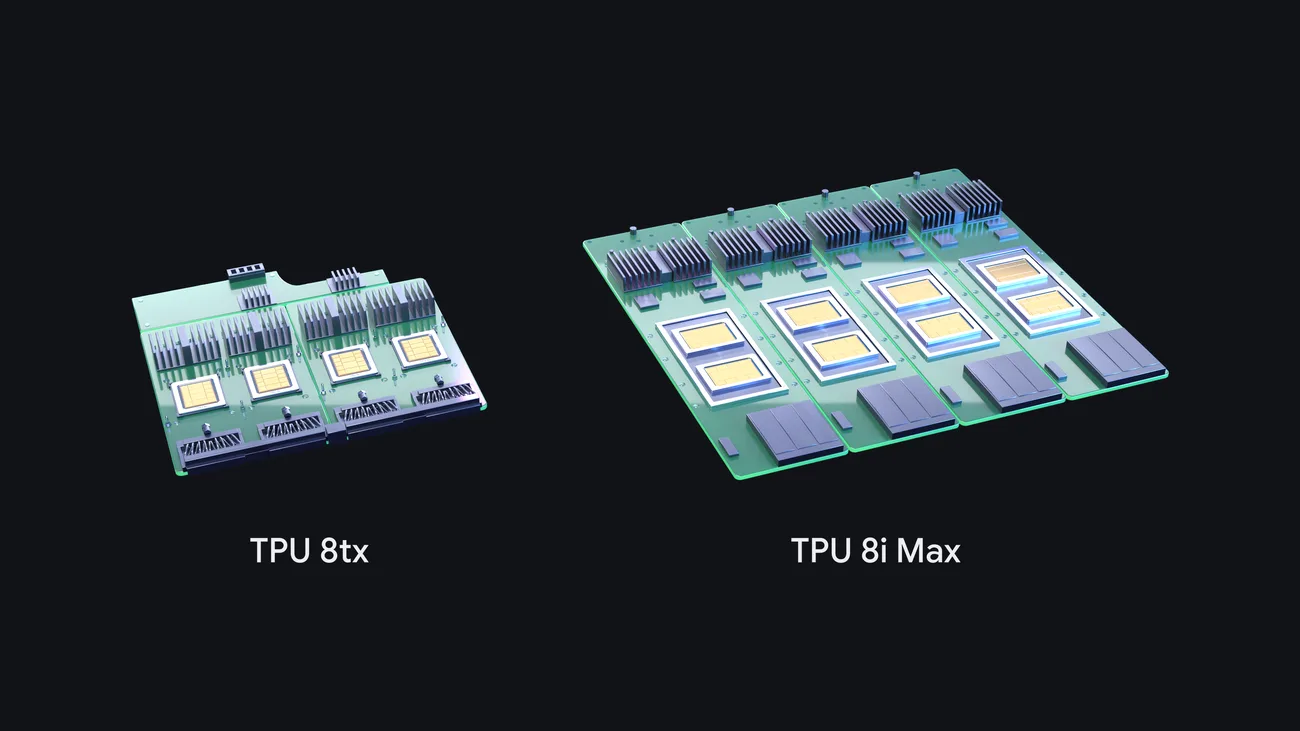
Image: Google
Google announced two new chips on November 9 as part of its eighth-generation TPU family. The announcement came from Amin Vahdat, SVP and Chief Technologist for AI and Infrastructure at Google. Google says this is the first time it has introduced four TPU systems in a single year.
The two chips solve different problems.
TPU 8tx is built on the same silicon as TPU 8t, Google’s training chip. The difference is hardware-level confidential compute, with the chips paired with 5th Generation AMD EPYC CPU hosts. Normally, data has to be unlocked in memory while a computer processes it. TPU 8tx keeps sensitive data and model weights protected and isolated even while in active use. Google says it is built for regulated enterprises and governments running frontier or proprietary models and autonomous agents alongside their most sensitive data. In a media briefing, Google also said select customers will be able to deploy TPU 8tx in their own data centers. Google says TPU 8tx delivers up to 2x lower latency compared to TPU 8t.
TPU 8i Max takes a different approach. Google combined two TPU 8i chips into a single package. That doubles compute, SRAM, and HBM bandwidth compared with the standard TPU 8i. Google’s framing: when dozens of AI agents work across an entire codebase or hours of video at once, memory bandwidth quickly becomes the bottleneck. TPU 8i Max addresses that directly, and Google says it fits twice the silicon within the existing rack footprint.
Both systems are expected to be available to cloud customers in 2027, based on reporting by The Next Platform on the hardware rollout schedule.
Why it matters: The confidential computing story on 8tx is not new as a concept. The question has always been: does it come with a performance penalty that makes it impractical? Google says the 8tx runs with near-zero performance cost. That matters. A confidential computing option that runs with a steep performance penalty is a theoretical feature. One that Google says runs with near-zero performance cost is a real procurement option. The 8i Max is simpler to evaluate. Double the HBM bandwidth, same rack footprint. If your bottleneck is context window handling in multi-agent workloads, that is the right lever.
Find out more: Google’s Introducing TPU 8tx and TPU 8i Max