
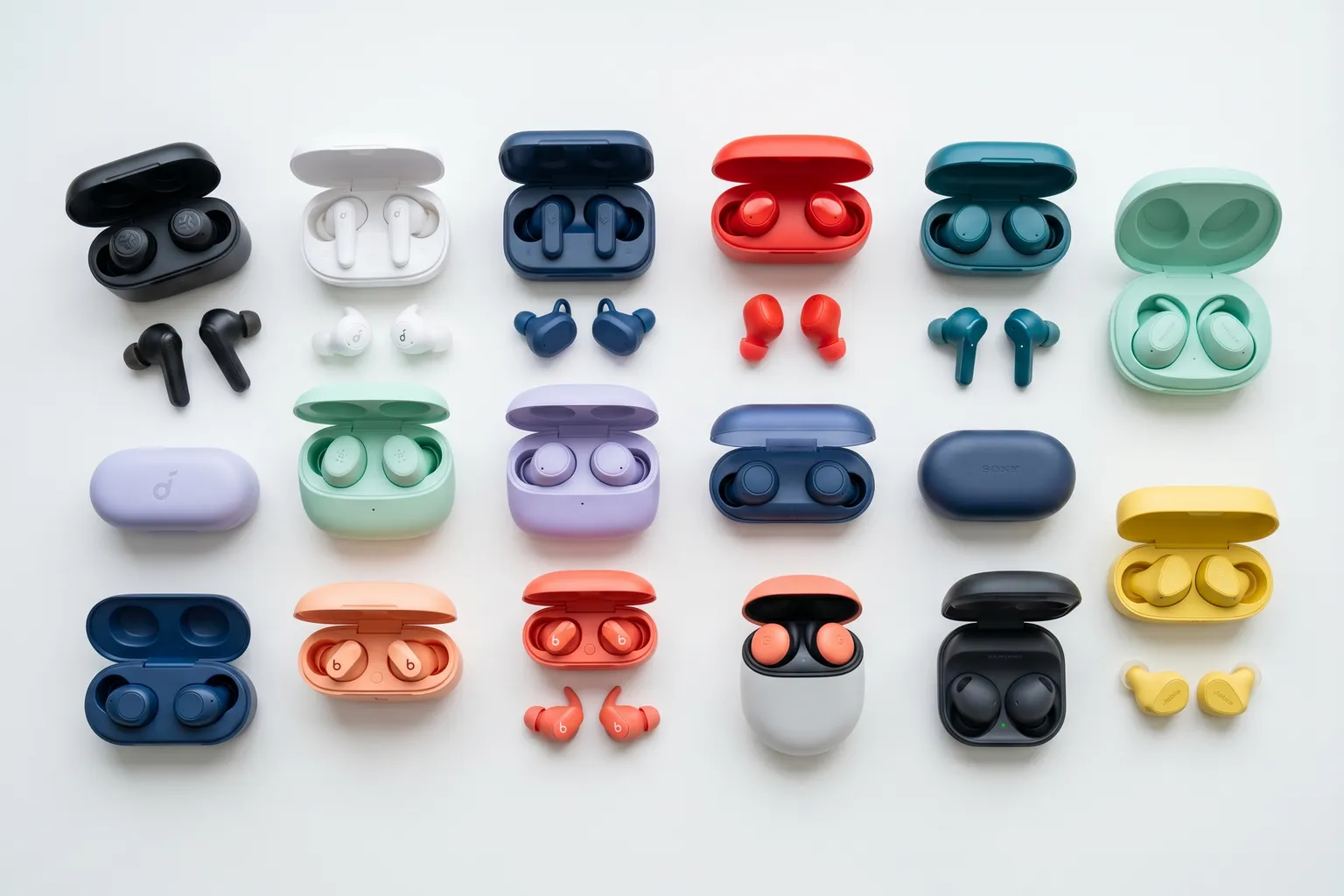
- JLab Go Air Pop+ is the best earbuds under $25 — period. $25 for actual wireless earbuds that stay in your ears.
- TOZO T10 is the $25 competitor with better battery (55 hours total with case) and IPX8 waterproofing
- EarFun Air is the clear winner at the $40 tier — IPX7, 35-hour total battery, Qi wireless charging, 4 mics
- Sony WF-C500 is the $45 pick that actually sounds like a Sony product — small, light, better audio than competitors
- Samsung Galaxy Buds 3 FE adds ANC to the budget conversation at $85, though the ANC isn't flagship-quality
- Soundcore Liberty 5 rounds out the $80 tier with a 6-mic call array, adaptive ANC, and Dolby Audio support
- Cheap earbuds are not what they were in 2022 — the $25 tier is legitimately usable now
TL;DR: Under $25: JLab Go Air Pop+ or TOZO T10. Under $45: EarFun Air or Sony WF-C500. Under $90: Samsung Galaxy Buds 3 FE for ANC. Under $80: Soundcore Liberty 5 for calls. All seven are real earbuds that work — not a throwaway recommendation in the bunch.
The budget earbud category is actually good now. I say that with some surprise, because two years ago “budget earbuds” meant “earbuds that fall out, have muddy audio, and die in four months.” That’s not the case in 2026. The TOZO T10 has IPX8 waterproofing and 55 hours of battery life. The EarFun Air has Qi wireless charging. The JLab Go Air Pop+ costs $25 and stays in your ears.
This roundup covers 7 picks across three price tiers under $60. No filler. Every pick here is something I’d actually recommend to a friend.
Quick Comparison: Best Budget Earbuds 2026
| Earbuds | Price | Battery | Water Rating | ANC | Standout |
|---|---|---|---|---|---|
| JLab Go Air Pop+ | ~$25 | 35 hrs total | IPX4 | No | Best sub-$25, period |
| TOZO T10 | ~$25 | 55 hrs total | IPX8 | No | IPX8 at $25 is unreal |
| EarFun Air | ~$40 | 35 hrs total | IPX7 | No | Wireless charging, 4 mics |
| Sony WF-C500 | ~$45 | 20 hrs total | IPX4 | No | Sony sound in a tiny package |
| Samsung Galaxy Buds 3 FE | ~$85 | 21 hrs total | – | Yes | ANC enters the budget tier |
| Soundcore Liberty 5 | ~$80 | – | – | Yes | Call quality leader |
Under $25 Tier
JLab Go Air Pop+ — Best Under $25
Price: ~$25 | Check on Amazon
I was skeptical. $25 for true wireless earbuds sounds like it should produce something miserable. It doesn’t.
The Go Air Pop+ has three EQ settings (Signature, Balanced, Bass Boost) that you can toggle without an app — just triple-tap the earbud. JLab shrank the case 15% and the buds 40% lighter than the original Go Air, and the fit is compact with a half-in-ear design that works for most ear shapes. Battery is 9+ hours per earbud with 26+ more in the case — 35 total.
The IPX4 splash resistance handles sweat. Dual connect lets each earbud work independently as a mono earbud. Bluetooth 5.1 connects quickly and holds stable.
Sound quality: it’s $25 audio. Compressed soundstage, bass-forward tuning, limited detail. But it’s thoroughly listenable for calls and podcasts — which is the actual use case for most budget earbud buyers. Put them in your ears during a commute and they work.
If you lose earbuds constantly and hate paying full price to replace them, this is your answer.
TOZO T10 — Best IPX8 Under $25
Price: ~$25 | Check on Amazon
The TOZO T10 competes directly with the Go Air Pop+ and brings different strengths. The headline is IPX8 — it can survive submersion up to 30 meters for 30 minutes. At $25, that’s absurd.
55 total hours of battery (7 hours per earbud + 48 in the case) is also remarkable for the price. The case supports wireless charging, which is a feature I didn’t expect to find at this price point.
The sound tuning is bass-heavy in a consumer-friendly way. Not accurate, but punchy and satisfying for gym use and casual listening. The fit uses a combination of an earbud and an ear tip to improve stability.
Trade-off: call quality is mediocre. Single mic per earbud without any beamforming means calls in noisy environments are a mixed experience. If calls matter, go with the JLab. If waterproofing and battery life matter, go TOZO.
Under $45 Tier
EarFun Air — Best at $40
Price: ~$40 | Check on Amazon
The EarFun Air is the budget tier’s overachiever. Things you don’t expect at $40: Qi wireless charging on the case, IPX7 waterproofing, four microphones (instead of the usual two), 35 total hours of battery.
Volume controls on the earbuds themselves (not just touch gestures for play/pause) are a practical convenience that most cheap earbuds skip. The PEEK + PU driver combination produces clearer highs than most budget earbuds — it’s not audiophile sound, but it’s noticeably better than $25-tier alternatives.
Call quality is competitive for the price — the four-mic array does real noise reduction. Not Soundcore Liberty 5-level, but noticeably better than single-mic budget earbuds.
The EarFun Air is the pick if you want meaningful feature upgrades over the $25 tier without crossing $50. Everything about it is a step up.
Sony WF-C500 — Best Sound at $45
Price: ~$45 | Check on Amazon
Sony could have charged $70 for the WF-C500 and it wouldn’t have been scandalous. Instead they priced it around $45, which creates awkward conversations for everyone else in this tier.
The sound signature is balanced — not bass-boosted in the way most budget earbuds are, not thin and tinny. It sounds like Sony tuned these properly rather than just hitting a price point. The size is small and the weight (5.4 grams per earbud) makes them genuinely comfortable for long sessions.
IPX4 splash resistance. 10 hours per earbud, 20 total. Sony’s 360 Reality Audio support (when paired with a Sony app) adds spatial audio processing. Alexa built-in.
The catch: no wireless charging, no ANC, no LDAC at this price. These are the features that went to fund the tuning quality. That’s a reasonable trade-off.
For music listeners who care more about how things sound than what feature box is checked: Sony WF-C500. For feature maximalists: EarFun Air.
Under $90 Tier
Samsung Galaxy Buds 3 FE — ANC Enters the Budget
Price: ~$85 | Check on Amazon
Samsung replaced the Buds FE with the Buds 3 FE, and it carries the same idea a tier up: an 11mm dynamic driver and improved active noise cancellation for less than the flagship Buds line costs.
The ANC works for basic noise reduction — HVAC, transit rumble, consistent background noise. It’s not Galaxy Buds Pro-level. It won’t block a jackhammer or restaurant conversation. But for office ambient noise or plane noise, it cuts meaningfully. Samsung also added Gemini voice-assistant access hands-free, which the original Buds FE didn’t have.
The wing-tip design locks the earbud in place well — better fit stability than most budget earbuds. Auto Switch Audio (if you have other Samsung devices) hands off playback automatically. Touch controls are customizable.
21 hours total battery. Samsung doesn’t publish a water-resistance rating for this generation on the Amazon listing, so treat it like the outgoing model and skip heavy sweat sessions or rain. Samsung’s Seamless codec delivers better audio than standard Bluetooth SBC when paired with a Samsung phone.
Works with Android and iOS, but the Galaxy Wearable app features are Android-only. If you’re on Android — especially Samsung — these are a strong pick. iPhone users can use them but lose most of the smarts.
The Picks That Didn’t Make the Cut
Soundcore Liberty 5 (~$80, ASIN: B0DT4F2NM9) sits in the same range as the Buds 3 FE but deserves its own mention: if you’re flexible on budget, its 6-mic AI call array is noticeably better than everything below it, and the adaptive ANC 3.0 system re-evaluates your environment every 0.3 seconds instead of applying one static profile. It’s also the first Soundcore earbud with Dolby Audio support. If you take a lot of calls, the premium is worth it.
TOZO NC9 / NC9 Plus: If you specifically want budget ANC earbuds, the TOZO NC9 series adds hybrid ANC for around $35-45. The ANC is functional but basic — not in the same league as the Galaxy Buds 3 FE, but cheaper.
What Budget Earbuds Actually Get Right (and Wrong)
What they get right in 2026:
- Battery life is legitimately good (30-55 hours total with case)
- Water resistance is standard now, even at $25
- Bluetooth stability is reliable at BT 5.1+
- Call quality for voice is acceptable
Where they still fall short:
- Audio quality for music has a ceiling — you’ll notice it with complex recordings
- ANC (where it exists) is basic
- Codec support is limited to SBC/AAC — no LDAC or aptX
- Build feel is plastic and light — these don’t feel premium
For most people’s actual use cases, the first column matters more than the second.