
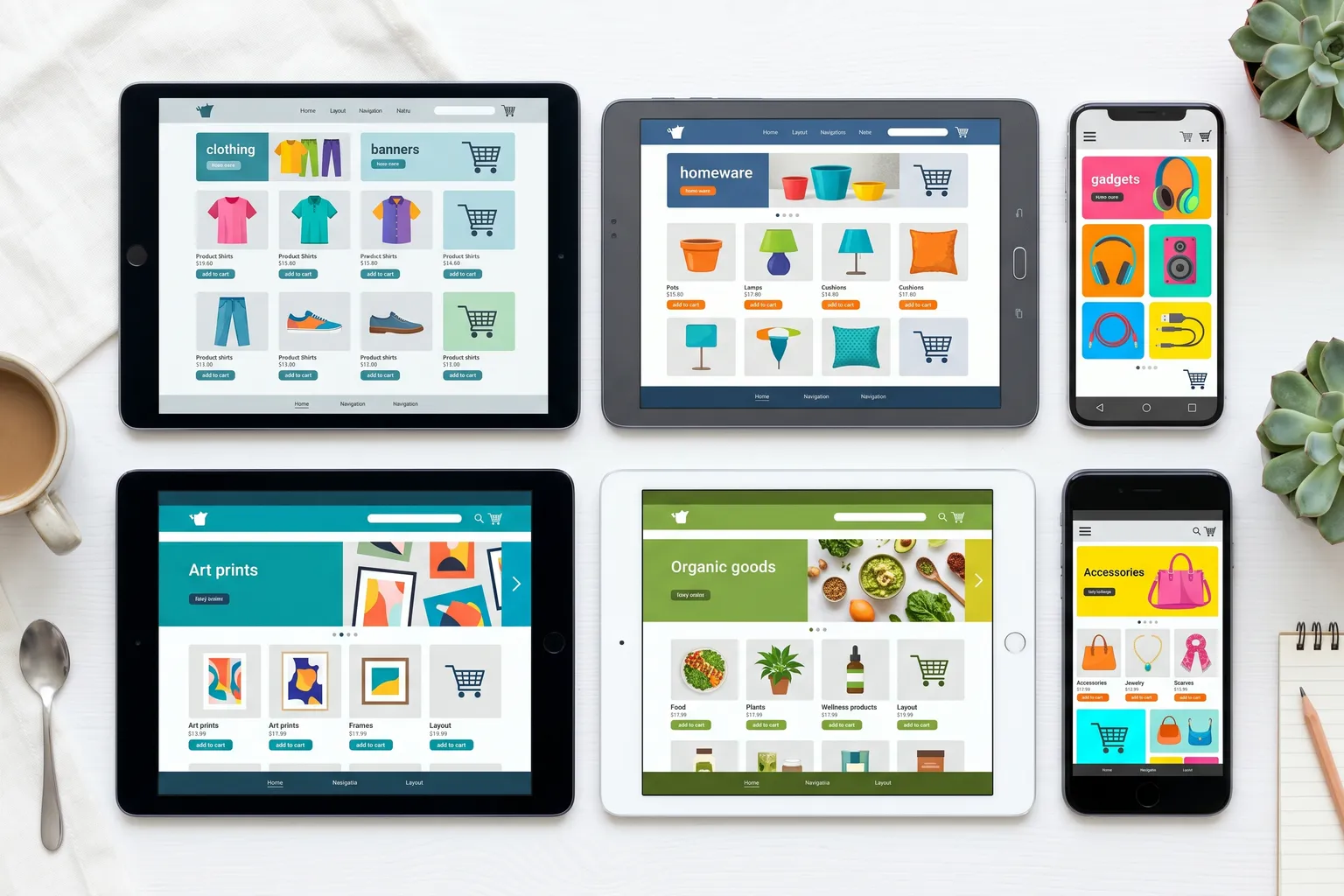
There are two types of ecommerce builders: ones designed for building websites that happen to sell things, and ones designed specifically for selling things.
Most of the best ones fall in the second category. This roundup covers both types honestly — because the right choice isn’t always the most powerful tool. It’s the one that fits your product, your technical comfort, and what you’re actually trying to accomplish.
Let me walk through each platform with enough specificity to actually help you decide.
Quick Rankings: Ecommerce Website Builders
| Platform | Starting Price | Best For | Transaction Fees | Rating |
|---|---|---|---|---|
| Shopify | $29/mo | Dedicated ecommerce stores | 0-2% (0% w/ Shopify Payments) | 9.2/10 |
| WooCommerce + Hostinger | $2.99/mo | Value-driven full control | None | 9.0/10 |
| BigCommerce | $29/mo | High volume, no fees | None | 8.7/10 |
| Wix | $29/mo (Core) | Design-forward small stores | None | 8.2/10 |
| Squarespace | $27/mo (Commerce) | Aesthetic-forward brands | None | 7.8/10 |
| Weebly/Square Online | Free–$26/mo | Simplest store setup | 0-2.9% | 7.0/10 |
1. Shopify — The Ecommerce Standard
Shopify is what an ecommerce platform looks like when the entire company is focused on one problem: making it as easy as possible to sell things online.
That focus shows in every part of the product.
Store setup: New store to accepting payments in under an hour. Product import (CSV or manual), payment gateway connection, shipping rate configuration, tax setup. The setup wizard is genuinely guided.
Checkout: Shopify’s checkout is one of the most optimized in the industry — fast-loading, mobile-first, clean flow. The one-page checkout introduced in 2024 reduced cart abandonment meaningfully for most stores. You can customize with Shopify’s checkout editor or via Shopify Scripts on higher tiers.
Abandoned cart: Email and SMS abandoned cart is native. Configuration is simple — delay, subject line, message, optional discount code. No app required for the basics.
Analytics: Shopify’s analytics dashboard shows the metrics that matter — total sales, conversion rate by traffic source, average order value, customer return rate, inventory forecast. The reports are clear and actionable without requiring a data analyst to interpret.
App ecosystem: 8,000+ apps. Payment gateways, loyalty programs, subscriptions, reviews, upsells, accounting sync, shipping logistics, print-on-demand. If you need a specific ecommerce capability, there’s almost certainly a Shopify app for it.
The honest downside: Transaction fees. Shopify Basic charges 2% if you don’t use Shopify Payments, 1% on Shopify, 0.5% on Advanced. If you’re processing $100K/month in volume and using a non-Shopify payment gateway, you’re paying $1,000-2,000/month in pure transaction fees. Use Shopify Payments where available (US, UK, Canada, Australia, others) and the fees go to zero.
App costs also add up — a typical Shopify store running reviews, loyalty, subscriptions, and upsell apps spends $50-200/month in app fees on top of the platform cost.
2. WooCommerce on Hostinger — Best Value for Full-Featured Stores
WooCommerce is Shopify’s capability at a fraction of the cost, with a trade-off: you’re running WordPress and responsible for your own stack.
That trade-off is smaller than it sounds on quality hosting.
Hostinger’s managed WordPress plans start at $2.99/month with LiteSpeed caching, one-click WordPress + WooCommerce install, and performance that handles real ecommerce traffic. What used to require significant technical knowledge to set up runs as a guided process in under 30 minutes.
What WooCommerce does that matches Shopify:
- Unlimited products, categories, and variants
- Multiple payment gateways (Stripe, PayPal, Authorize.net, and 100+ more via free plugins)
- Digital and physical products, variable products, grouped products
- Tax calculation and shipping rules
- Inventory management with stock level alerts
- Coupon and discount system
- Full customer account system with order history
What WooCommerce does better than Shopify:
- Zero transaction fees, period.
- Full code-level customization — change anything about the store
- Complete ownership of your data and platform (not hosted on someone else’s platform)
- Plugin ecosystem (WordPress plugins) extends to every possible use case
What’s more complex with WooCommerce:
- You manage updates (hosting handles server updates; you handle WordPress and plugin updates)
- Security is partly your responsibility — keep WordPress, WooCommerce, and plugins updated
- More configuration required to achieve the same defaults Shopify sets up automatically
For a store owner who’s comfortable with WordPress basics, WooCommerce on Hostinger is the most cost-effective serious ecommerce solution. The total cost for a WooCommerce store on Hostinger’s Business plan is around $5-10/month plus any premium extensions — vs. $29-79/month for Shopify before app costs.
3. BigCommerce — Best for High-Volume Stores
BigCommerce makes the most sense when you’re past the threshold where Shopify’s transaction fees and app costs become painful.
Zero transaction fees on every plan — Standard ($29/month), Plus ($79/month), Pro ($299/month). For a store processing $200K/month in sales, BigCommerce’s no-fee policy saves $1,000-4,000/month compared to Shopify depending on your payment gateway.
Native multi-channel selling: Google Shopping, Facebook/Instagram, Amazon, eBay, and other marketplaces are natively integrated in BigCommerce — not via third-party apps. For stores that sell across multiple channels, this simplifies operations significantly.
Catalog management at scale: BigCommerce handles catalogs of 10,000+ products more cleanly than Shopify at comparable plan pricing. Bulk editing, faceted search filters, custom product fields — the catalog management tools are built for genuine enterprise scale.
The trade-off: BigCommerce’s interface is less polished than Shopify’s for beginners, and the app ecosystem (1,500+ apps) is smaller than Shopify’s (8,000+). For niche integrations, Shopify is more likely to have what you need.
4. Wix — Best for Small Visual-First Stores
Wix Stores is the right ecommerce choice when you need a beautiful website and a capable store in one, and your store isn’t the sole focus of the business.
The Core plan at $29/month includes unlimited products, inventory management, multiple payment options, abandoned cart recovery, and the full Wix website builder. The design flexibility of Wix’s website builder extends to the store — product pages look like your brand, not like a default WooCommerce template.
For a clothing brand, an artisan food producer, or any business where visual presentation of products is the conversion mechanism, Wix’s design capability is the differentiator.
The limitation: advanced ecommerce analytics, complex inventory scenarios, and high-volume optimization favor Shopify. Wix Stores works beautifully up to a certain volume and complexity; beyond that, you’ll feel the ceiling.
See our full Wix review for the detailed breakdown. And for the broader small business context, our website builder roundup covers how Wix fits alongside budget alternatives.
5. Squarespace — The Aesthetic-Forward Choice
Squarespace’s ecommerce is best when the product is inherently beautiful and the shopping experience needs to feel premium.
Photography prints. Handmade jewelry. Premium skincare. Specialty food items. Categories where the visual impression of the store directly influences willingness to pay. Squarespace’s template quality and visual consistency create a luxury feel that’s difficult to replicate in Wix or Shopify’s default themes.
Commerce Basic at $27/month removes transaction fees (Business plan at $23/month charges 3%). Unlimited products, inventory management, digital downloads, subscriptions, product reviews — the Commerce tier is a solid feature set.
Where Squarespace ecommerce trails the competition: fewer payment options (Stripe, PayPal, Afterpay — the list is shorter than Shopify or WooCommerce), less analytics depth, and an app ecosystem that doesn’t match Shopify or even Wix for specialized integrations.
6. Weebly/Square Online — Simplest Store Setup
For a business already using Square’s payment system (a brick-and-mortar shop adding online selling), Square Online (built on Weebly) provides the cleanest path to an integrated online/offline inventory system.
Products added to Square Online sync to your Square POS. Inventory is shared across your physical and online store. For a small retailer managing a single product catalog across channels, this simplification is genuinely valuable.
For a store that isn’t already in the Square ecosystem, there are better options at every feature level.
How to Choose
Answer these questions:
- Is ecommerce your primary business? → Shopify (convenience and ecosystem) or WooCommerce on Hostinger (cost efficiency).
- Are you processing $100K+/month in volume? → BigCommerce for the no-fee structure.
- Does your brand live or die on visual presentation? → Squarespace if it’s a small premium catalog. Wix if you also need website flexibility.
- Is cost the primary constraint? → WooCommerce on Hostinger — full ecommerce capability starting around $3/month.
- Are you already using Square for point-of-sale? → Square Online for integrated inventory.
For the majority of new online stores, the decision comes down to Shopify (easiest, best ecosystem, higher cost) vs. WooCommerce on Hostinger (lowest cost, full control, slightly more setup). Both are excellent. Which one fits you depends on your comfort with WordPress and how much the monthly cost difference matters.