
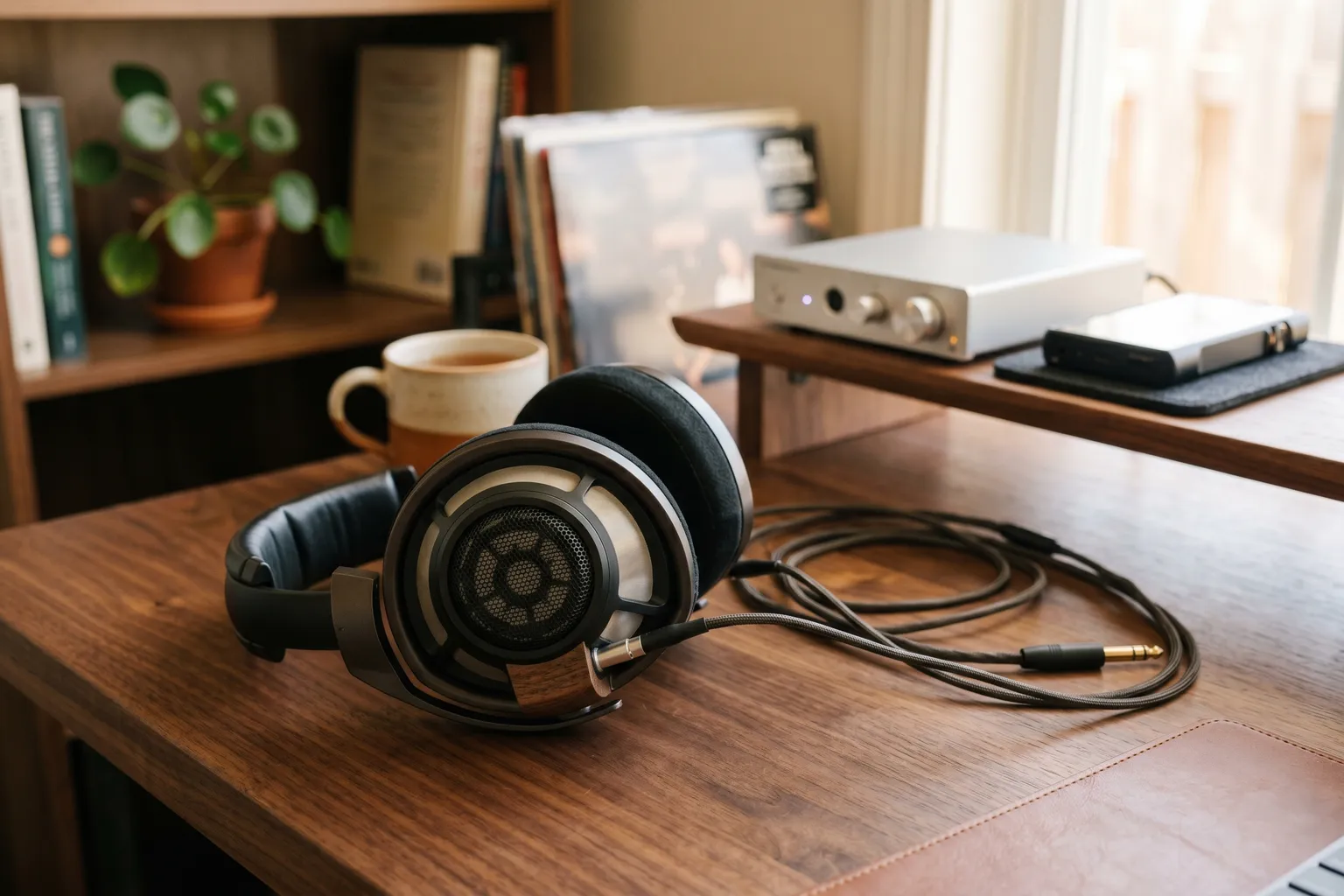
- Open-back headphones sound more natural than closed-back — instruments have space, imaging is wider, there's no 'inside your head' pressure
- They're useless in public — everyone around you hears your music, you hear everything around you. Home and studio use only.
- Sennheiser HD 599SE is the best all-rounder for most people — neutral tuning, wide soundstage, solid build, reasonable price
- Beyerdynamic DT 990 Pro is the classic studio open-back — detailed treble, punchy bass, the 250-ohm version needs an amp
- Philips SHP9600 is the budget audiophile entry — $65 for a soundstage that rivals headphones costing twice as much
- Grado SR80 is the entry point to Grado's cult-favorite sound — forward mids, detailed, but polarizing comfort
TL;DR: Sennheiser HD 599SE for the best all-around open-back under $200. Beyerdynamic DT 990 Pro for the classic studio experience. Philips SHP9600 if you want to spend $65 and still get a real soundstage. Grado SR80 for the cult following and forward-mid sound. Audio-Technica ATH-AD700X for competitive gaming and instrument separation.
Open-Back vs Closed-Back: What Actually Changes
Most people’s first headphone experience is closed-back. Sealed ear cups, good isolation, music delivered directly into your ears. It’s fine. It works.
Open-back is different in a way that’s hard to describe without experiencing it. The ear cups have openings — mesh grilles, perforations, latticed backs — that let air move through. Sound doesn’t get trapped inside the cup, and it doesn’t get trapped inside your head.
The result: wider soundstage. More natural instrument placement. Less pressure buildup over long listening sessions. You’ll hear the reverb in a recording more clearly. You’ll place instruments left, right, and in depth in a way that closed-back compresses into a narrower image.
What you sacrifice: isolation. Completely. Open-back headphones don’t block external noise, and they leak sound to everyone around you. They’re a home tool. Using them in a coffee shop or open office is rude to everyone nearby and defeats the point.
For home listening, studio work, and audiophile critical listening, they’re often worth the trade-off. Here’s what to look at in 2026.
Quick Comparison: Best Open-Back Headphones 2026
| Headphone | Price | Impedance | Amp Required? | Best For |
|---|---|---|---|---|
| Sennheiser HD 599SE | ~$148 | Lower impedance | Optional | All-purpose home listening |
| Beyerdynamic DT 990 Pro | ~$180 | 250 ohms | Yes (250 ohm) | Studio mixing, audiophile listening |
| Audio-Technica ATH-AD700X | ~$130 | 38 ohms | No | Gaming, instrument separation |
| Philips SHP9600 | ~$65 | 32 ohms | No | Budget entry to open-back |
| Grado SR80 | ~$175 | 32 ohms | No | Forward mids, vocal presence |
| Sennheiser HD 599 | ~$200 | 50 ohms | No | Comfort-first home listening |
1. Sennheiser HD 599SE — Best Overall
Price: ~$148 | Check on Amazon
Sennheiser discontinued the HD 560S, and the HD 599SE fills the same role: a sensible, audiophile-grade open-back with a spacious soundstage and none of the hyped bass or artificial sparkle. It’s built for classical, acoustic, and high-fidelity listening rather than chasing a genre-specific sound signature.
The lower impedance than the old 560S means it’s genuinely easier to drive from a phone, laptop, or tablet without a dedicated amp. You lose a little of the extra headroom a proper DAC/amp would unlock, but you also lose the requirement, since this one runs comfortably straight out of most consumer devices.
The build carries over Sennheiser’s usual approach at this tier: plush velour ear pads for long sessions, and a detachable cable setup. It ships with both a 3-meter 6.3mm cable and a 1.2-meter 3.5mm cable, covering home amp setups and portable use without buying an adapter separately.
Verdict: The most balanced recommendation for someone entering open-back listening or setting up a home listening station. Audiophiles who want to spend more move to the HD 650 or HD 800S — but the 599SE is the pragmatic entry to Sennheiser’s house sound now that the 560S is gone.
2. Beyerdynamic DT 990 Pro — Studio Classic
Price: ~$180 | Check on Amazon
The DT 990 Pro is a studio workhorse that’s been in professional and enthusiast use for decades. It’s not subtle.
The sound signature is V-shaped with significant emphasis: elevated bass, prominent treble peak, slightly recessed mids. This makes it analytical for mixing — you hear bass detail and high-frequency air clearly, which helps with EQ decisions. For casual listening, some people find the treble emphasis fatiguing over long sessions. Some people love it.
The 250-ohm version (the standard Pro model) genuinely needs amplification. Under-powered, it sounds thin and lacks bass authority. With a proper amp, it opens up. This isn’t optional — if you’re getting the 250-ohm version, budget for at least a $40-50 USB DAC.
The build is notably good for this price — metal headband, replaceable velour ear pads, coiled cable. The DT 990 Pro is built to last in a studio environment. Reviews consistently note that the build quality is the most durable in this tier.
Comfort is wide, well-padded, with moderate clamping. It’s designed for long sessions.
Two important things: First, there’s also an 80-ohm version that runs fine from a laptop or phone. Second, the 250-ohm version is often the better-sounding option when properly powered.
Verdict: If you want the classic studio open-back experience and have amplification (or are willing to get it), the DT 990 Pro is a proven, durable choice that sounds excellent when properly driven.
3. Audio-Technica ATH-AD700X — Best for Gaming
Price: ~$130 | Check on Amazon
The ATH-AD700X has developed a devoted following in competitive gaming communities, and for a specific reason: its imaging.
Open-back headphones generally image well, but the AD700X is unusually precise about it. Footsteps, gunfire, environmental audio — you can place them directionally with more confidence than closed-back headphones at this price. Gaming headsets at $200+ often lose to the AD700X on spatial accuracy.
The 3D Wing Support headband is Audio-Technica’s distinctive self-adjusting design — no clamp pressure adjustment needed, the wings expand to your head size. This is either comfortable or uncomfortable depending on head shape. Most people find it excellent for long sessions; people with narrow heads sometimes find it doesn’t grip enough.
At 38 ohms, no amp required. Runs cleanly from a laptop or phone headphone jack.
The sound is light on bass, which is the trade-off for the excellent midrange and treble precision. It’s not a bass-heavy headphone. For gaming, this works fine — instrument separation and positional audio matter more than bass slam. For music with heavy bass emphasis, you’ll notice the trade-off.
Verdict: The best open-back pick for competitive or immersive gaming. Also excellent for orchestral music and recordings where instrument separation and soundstage are the priorities.
4. Philips SHP9600 — Best Budget Open-Back
Price: ~$65 | Check on Amazon
The SHP9600 is the first thing I’d recommend to someone who wants to experience open-back listening without spending $150+. And it’s not a “budget compromise” recommendation — this headphone genuinely sounds good in a way that embarrasses its price.
50mm neodymium drivers, 32-ohm impedance (no amp needed), comfortable design with room for glasses and large ears. The sound is warm and natural with a wider soundstage than its price suggests.
Is it the most detailed or resolving open-back in this roundup? No. The HD 599SE has more precision, the DT 990 Pro has more analytical treble, the AD700X images more precisely. But the SHP9600 is genuinely enjoyable to listen through, comfortable for hours, and cheap enough that it’s a low-risk entry point.
Also practical for gaming, audiobook listening, and anything where you want open-ear sound at home without spending a lot.
Verdict: The $65 starting point for open-back listening. If you’ve never tried it and don’t know if you’ll like it, start here.
5. Grado SR80 — Best Midrange and Vocal Presence
Price: ~$175 | Check on Amazon
Grado is a Brooklyn-based company with a cult following and a sound signature that divides opinion. The SR80 either sounds alive and musical or too forward and bright, depending on who you ask.
What’s not in dispute: the midrange presence. Vocals, guitars, piano — instruments that live in the midrange spectrum sound immediate and present in a way that Sennheiser’s more neutral approach doesn’t match. For acoustic music, jazz, and rock, many listeners prefer Grado’s tuning to more neutral alternatives.
The comfort story is more complicated. Grado uses on-ear rather than over-ear cups, and their supra-aural design presses against the ear rather than surrounding it. For sessions under 2 hours, most people find it fine. For longer sessions, the pressure can become noticeable. The original Grado foam pads are famously divisive — many owners replace them immediately.
At 32 ohms, no amp needed. Build is simple — plastic body, fixed cable, foam pads. Grado headphones look like they’re from the 1990s because many of the designs are from the 1990s. The engineering focus is entirely on the driver, not the aesthetics.
Verdict: For acoustic music, vocal-centric recordings, and listeners who want forward, engaging mids rather than neutral precision, Grado’s entry-level is worth the polarizing aesthetics and comfort trade-off.
6. Sennheiser HD 599 — Best for Long Listening Sessions
Price: ~$200 | Check on Amazon
If the HD 599SE is the analytical choice, the HD 599 is the comfort choice. Slightly warmer tuning, very plush velour ear pads, an extremely relaxed fit that disappears over long sessions.
The HD 599 is also more forgiving of poor recordings — its tuning doesn’t spotlight compression artifacts and harshness as aggressively as the 599SE. This makes it better for streaming services and older recordings. The 599SE rewards high-quality sources; the 599 is more all-day-anything.
At 50 ohms, it runs fine from any headphone output. No amp required.
The “ivory” color scheme is either elegant or ugly depending on your taste. Functionally, it’s one of the best everyday open-back headphones if your priority is long-session comfort over analytical precision.
Who Should Buy Open-Back Headphones?
Open-back makes sense if:
- You listen at home where you can control your environment
- You’re doing critical music listening and care about soundstage
- You’re mixing or producing music and want accuracy
- You play games and want better spatial audio
- You do long listening sessions where ear fatigue is a concern
Skip them if:
- You’re commuting, in a coffee shop, or in an office
- You live with people who’d be annoyed by sound bleed
- You need to take calls and don’t want ambient noise on the call
- You exercise wearing headphones
Related Reading
If you need headphones that work outside the home, see our best noise cancelling headphones roundup for the top ANC picks. Budget-conscious? Our best headphones under $100 guide covers the picks that keep it under a hundred bucks.